
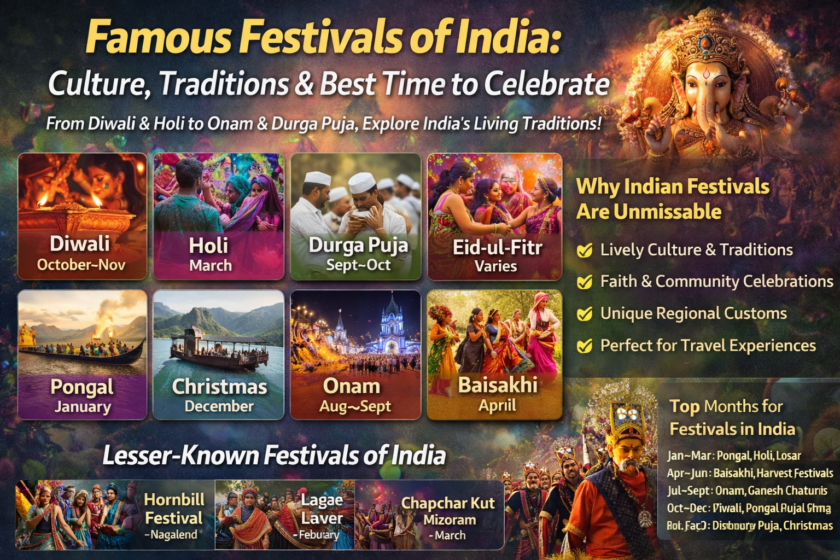
India a Living Calendar of Festivals
India is often described as a living calendar of celebrations, and the famous festivals of India prove exactly why.
Instead of measuring time only in days or months, we measure it in festivals. A harvest marks one celebration, a change of season brings another, while faith adds color to almost every week of the year. From snow-covered villages in the Himalayas to sun-soaked coastal towns, the famous festivals of India pulse through everyday life like a shared heartbeat.
When you travel across the country, you don’t just see places — you feel moments. Drums echo through narrow lanes, lamps glow like fallen stars, colors burst into the air, and prayers rise softly at sunrise. These famous festivals of India are not performances for tourists; they are lived traditions, passed down like family stories.
Let’s walk through India’s most iconic festivals, understand their culture and traditions, and discover the best time to celebrate each one — whether you’re a curious traveler, a culture lover, or a first-time visitor.
Why the Famous Festivals of India Are the Soul of Its Culture
Festivals in India are not just holidays. Moreover They are emotional anchors. They connect people to nature, mythology, history, and each other. Consequently, Every festival carries a message — gratitude, renewal, victory of good over evil, or simply joy.
For travelers, festivals offer the most authentic cultural experience. You eat what locals eat, follow their rhythms, and become part of something deeply personal yet beautifully shared.
Diwali – One of the Most Famous Festivals of India
Best Time to Celebrate: October–November
Famous In: Pan-India (especially North & West India)
Diwali feels like the entire country holding a candle together. Homes glow with oil lamps, fireworks paint the sky, and laughter spills into the streets.
Cultural Significance
Diwali symbolizes the victory of light over darkness and good over evil. because It marks Lord Rama return to Ayodhya after exile.
Traditions & Rituals
- Lighting diya
- Lakshmi Puja
- Sharing sweets
- Decorating homes with rangoli
If you want to feel India’s warmth in its purest form, Diwali is the moment.Diwali stands tall among the famous festival of India, blending devotion, joy, and family traditions.

Holi – A Colorful Celebration Among Famous Festivals of India
Best Time to Celebrate: March
Famous In: Uttar Pradesh, Rajasthan, Delhi, Mathura, Vrindavan
Holi breaks every barrier. Age, status, language — all disappear under clouds of color.Holi remains one of the most joyful famous festivals of India, celebrated with color, music, and open hearts.
Cultural Significance
Holi celebrates love, forgiveness, and the arrival of spring.
Traditions & Rituals
- Playing with colors
- Holika Dahan (bonfire)
- Singing folk songs
- Traditional sweets like gujiya
Holi doesn’t ask who you are. It simply invites you to join.
Durga Puja – Power, Art & Devotion
Best Time to Celebrate: September–October
Famous In: West Bengal, Assam
Durga Puja transforms cities into open-air art galleries. Massive idols, creative pandals, and rhythmic drums create a hypnotic atmosphere.
Cultural Significance
The festival celebrates Goddess Durga’s victory over evil.
Traditions & Rituals
- Idol installations
- Cultural performances
- Sindoor Khela
- Immersion ceremonies
Durga Puja feels like devotion dressed in celebration.Durga Puja is one of the most artistic famous festivals of India, where devotion meets creativity and community spirit.
Navratri & Dussehra – Nine Nights of Energy
Best Time to Celebrate: September–October
Famous In: Gujarat, Karnataka, North India
Navratri dances through nine nights, while Dussehra ends with roaring effigies and roaring crowds.
Cultural Significance
These festivals honor feminine power and the triumph of righteousness.
Traditions & Rituals
- Garba & Dandiya
- Fasting
- Ram Leela performances
- Burning of Ravana effigies
It’s faith, movement, and drama rolled into one.
Together, Navratri and Dussehra rank among the most powerful cultural festivals of India, celebrated with devotion, dance, and storytelling.
Eid-ul-Fitr – A Celebration of Gratitude
Best Time to Celebrate: Varies (Islamic calendar)
Famous In: Across India
Eid mornings begin with prayers and end with overflowing plates.
Cultural Significance
Eid marks the end of Ramadan, a month of fasting and reflection.
Traditions & Rituals
- Community prayers
- Charity (Zakat)
- Family feasts
- Sharing sweets like sheer khurma
Eid teaches that joy tastes better when shared.Eid-ul-Fitr beautifully represents the spiritual diversity found in the famous festivals of India.
Christmas – Quiet Joy & Celebration
Best Time to Celebrate: December
Famous In: Goa, Kerala, Northeast India
Christmas in India blends global traditions with local warmth.
Cultural Significance
Celebrates the birth of Jesus Christ.
Traditions & Rituals
- Midnight mass
- Carol singing
- Decorated churches
- Plum cakes and sweets
In India, Christmas feels less loud and more heartfelt.
Christmas has become an important part of modern Indian festivals and traditions, blending faith with warmth.
Pongal – Harvest of Gratitude
Best Time to Celebrate: January
Famous In: Tamil Nadu
Pongal smells like freshly cooked rice and new beginnings.
Cultural Significance
It thanks the Sun God and nature for harvest abundance.
Traditions & Rituals
- Cooking Pongal dish
- Decorating homes with kolam
- Honoring cattle
Pongal reminds us that food begins in fields, not stores.Pongal highlights the agricultural roots of the traditional festivals of India.
Onam – Kerala’s Cultural Pride
Best Time to Celebrate: August–September
Famous In: Kerala
Onam is graceful, green, and deeply rooted.
Cultural Significance
Celebrates the return of King Mahabali.
Traditions & Rituals
- Snake boat races
- Floral rangoli (Pookalam)
- Onam Sadya feast
- Traditional dances
Onam feels like harmony served on a banana leaf.Onam stands out among the famous festivals of India for its deep cultural harmony and community bonding.
Baisakhi – Joy of the Harvest
Best Time to Celebrate: April
Famous In: Punjab
Baisakhi bursts with energy, music, and gratitude.
Cultural Significance
Marks the Sikh New Year and harvest season.
Traditions & Rituals
- Bhangra & Gidda
- Gurudwara prayers
- Community meals
It’s happiness with a beat.Baisakhi is one of the most joyful harvest festivals of India, filled with music and gratitude.
Ganesh Chaturthi – Faith Meets Festivity
Best Time to Celebrate: August–September
Famous In: Maharashtra
Ganesh Chaturthi turns devotion into a city-wide celebration.
Cultural Significance
Honors Lord Ganesha, remover of obstacles.
Traditions & Rituals
- Idol installations
- Community gatherings
- Grand immersions
Faith here dances on the streets.Ganesh Chaturthi is among the most celebrated famous festivals of India, especially in western regions.
Lesser-Known Famous Festivals of India You Should Know
Hornbill Festival – Nagaland (December)
A vibrant showcase of tribal culture, music, and crafts.
Losar – Ladakh (February)
Tibetan New Year with rituals, dances, and monasteries.
Chapchar Kut – Mizoram (March)
A joyful spring festival with bamboo dances.
These festivals offer intimate cultural experiences away from crowds.
Best Time to Experience the Famous Festivals of India
Here is the table showing the best time to experience the famous festivals of India:
| Months / Period | Famous Festivals |
| January – March | Pongal, Holi, Losar |
| April – June | Baisakhi, Regional Harvest Festivals |
| July – September | Onam, Ganesh Chaturthi |
| October – December | Diwali, Durga Puja, Christmas |
There’s no off-season for festivals in India.
Travel & Celebration Tips for Festival-Goers
- Book accommodation early
- Dress modestly
- Respect local customs
- Ask before photography
- Travel slow and stay curious
Festivals reward patience and openness. Experiencing the famous festivals of India becomes richer when you travel slowly and respectfully.
How the Famous Festivals of India Tell Living Stories
India’s famous festivals are not frozen traditions. They evolve, breathe, and adapt — just like the people celebrating them. When you experience these festivals, you don’t just witness culture. You participate in it.
Each celebration teaches something — gratitude, unity, joy, or hope. And long after the music fades, the feeling stays.
Final Thoughts
If you truly want to understand India, don’t start with monuments. Start with festivals. Stand in a crowd, share a meal, light a lamp, throw some color, and let India meet you halfway. That’s where the real journey begins.
Frequently Asked Questions (FAQ) About Famous Festivals of India
Q1: What are the most famous festivals in India?
A1: India celebrates a wide variety of festivals, but some of the most famous include Diwali, Holi, Durga Puja, Navratri, Eid-ul-Fitr, Christmas, Pongal, Onam, Baisakhi, and Ganesh Chaturthi. Each festival reflects the country’s rich culture, traditions, and regional diversity.
Q2: When is the best time to experience India’s festivals?
A2: Festivals occur throughout the year. January–March is ideal for Pongal, Holi, and Losar; April–June for Baisakhi and harvest festivals; July–September for Onam and Ganesh Chaturthi; and October–December for Diwali, Durga Puja, and Christmas.
Q3: Are India’s festivals suitable for tourists?
A3: Absolutely! India’s festivals are very tourist-friendly. However, it’s recommended to **book accommodation early, respect local customs, dress modestly, and follow safety tips** to enjoy the celebrations fully.
Q4: Which festival is best for first-time travelers to India?
A4: Diwali is often suggested for first-time travelers because it is celebrated nationwide, with stunning lights, sweets, and cultural experiences that provide a full immersion into Indian traditions.
Q5: Are there any lesser-known festivals worth visiting?
A5: Yes! Festivals like the Hornbill Festival in Nagaland, Losar in Ladakh, and Chapchar Kut in Mizoram offer unique cultural experiences away from tourist crowds.
Q6: What should travelers keep in mind when attending festivals in India?
A6: Travelers should dress appropriately, respect local traditions, ask permission before taking photos, try local food, and be prepared for crowds. Festivals are a mix of devotion, joy, and community participation.